
Home Textile Manufacturing Capabilities
Cairun Home Textiles operates a 6,000 m² home textile factory in Shangrao, Jiangxi, China, with 10 production lines and 30 people producing across 17 product categories. This page sets out what happens on site, in what order, and what each checkpoint can and cannot tell a buyer.
1. The Factory in Numbers
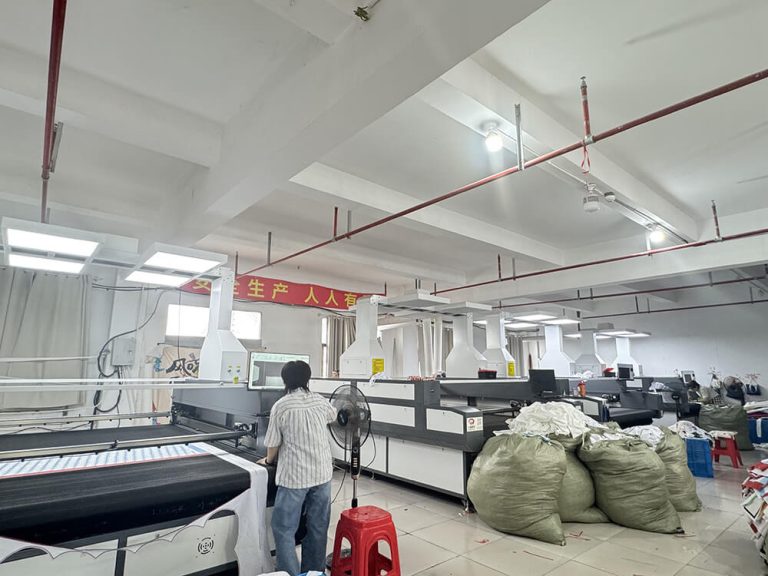
In one paragraph: 6,000 m² of production space in Shangrao, Jiangxi, China, 10 production lines and a team of 30. The seven production steps — fabric processing, cutting, sewing, heat-transfer printing, digital sublimation printing, finishing and packing — are all carried out in-house, which is what allows a printed program to be quoted as one schedule rather than as a fabric order plus a separate print order.
Production capability is quoted as 3,000–5,000 pcs/day, 80,000–120,000 pcs/month and approximately 1,000,000 pcs/year. These are capacity figures, not a delivery commitment for a specific order: a delivery date comes from the quotation after the specification, the quantity per design and the sample approval are settled. Reading capacity as a lead time is the most common error buyers make from a factory profile, which is why the wholesale page quotes the timing separately.
2. The Production Sequence
Seven steps run in this order on site. Each one has a failure mode that shows up later if it is skipped, so the checkpoint that follows it is listed alongside.
| Step | What happens | What it decides downstream |
|---|---|---|
| 1. Fabric processing | The greige fabric is prepared for cutting and printing | Hand feel, dimensional behaviour and how the print will sit in the surface |
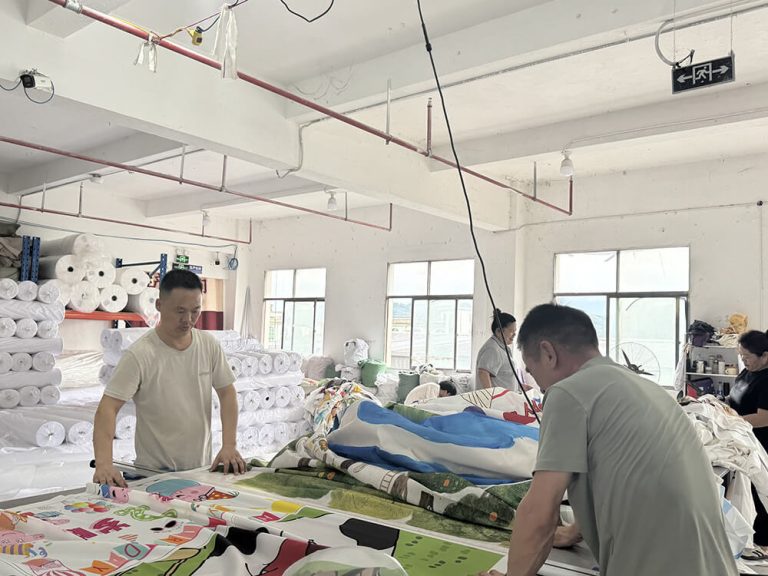
| 2. Cutting | Panels are cut to the finished size plus seam allowance, from the approved specification | Whether the finished piece measures what was approved |
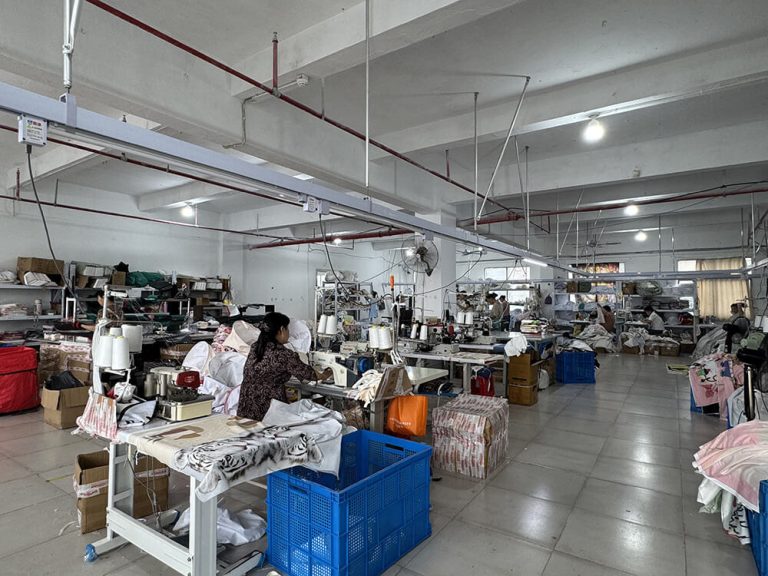
| 3. Sewing | Construction is assembled — hem, edge, backing, sleeve, opening, per category | Whether the piece survives service and washing as intended |
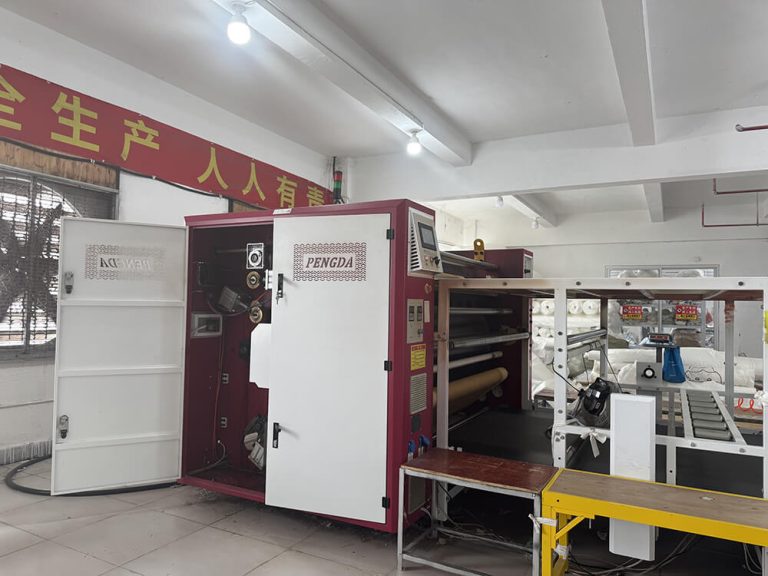
| 4. Heat-transfer printing | A printed film is applied to the fabric surface under heat and pressure | Placement accuracy and colour on discrete graphics, logos and panels |
| 5. Digital sublimation printing | Dye is transferred into the fibre under heat and pressure | All-over pattern, photographic artwork and gradient fidelity |
| 6. Finishing | Final trim, pressing and any category-specific finish | The appearance a buyer judges on the sample |
| 7. Packing | Polybag, insert card, hang tag, barcode and carton marking to the approved spec | Whether the retail pack is shelf-ready and the count is right |
Heat-transfer and digital sublimation are two routes, not interchangeable options: the fabric and the artwork together decide which one fits. The comparison is on the heat transfer printing page, and the commercial route through printing is on custom printed home textiles.
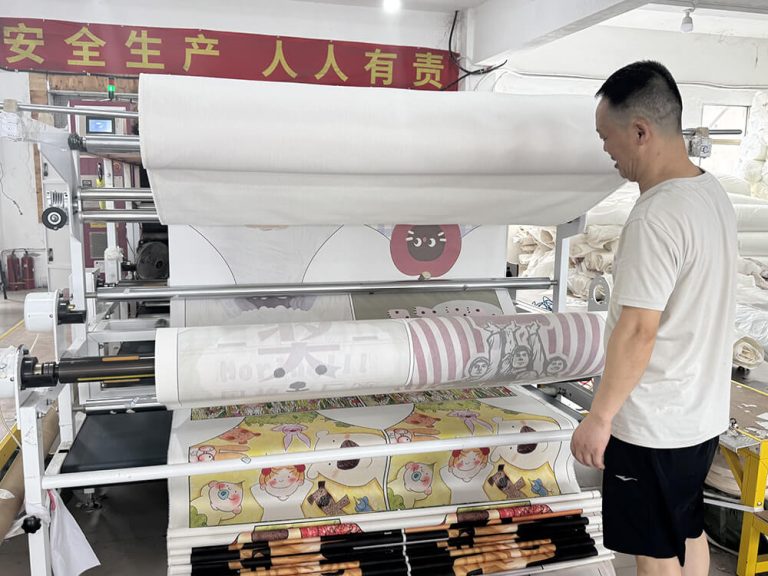
Inside Cairun's Production Floor
Six stages photographed on site, in the order production runs through them. Captions describe what is visible in each frame.

3. Printing Capability
| Parameter | Confirmed |
|---|---|
| Printing methods | Heat-transfer printing; digital sublimation printing |
| Maximum effective print width | 1.6 m / 160 cm / approx. 63 in |
| Sublimation-suitable fabrics | Polyester, polyester blends, microfiber, Oxford fabric, peach skin fabric and other suitable synthetic fabrics |
| Artwork accepted | AI, PDF, PSD, high-resolution JPG, high-resolution PNG (EPS not accepted) |
| Colour reference | Pantone reference, physical sample or digital colour reference |
| Oversize handling | Artwork wider than 1.6 m effective print width requires engineering review |
Two limits are worth stating plainly. First, 1.6 m is a printing limit, not an instruction to a fixed joining method — a design wider than that is reviewed per project, and the practical construction is confirmed rather than assumed. Second, a natural-fibre requirement is not excluded, but it changes the printing route, so it has to be raised before sampling rather than after the artwork is approved.
4. Sampling: What a Sample Proves and What It Does Not
| Sample type | Confirmed timing |
|---|---|
| Standard sample | 5–7 days |
| Custom print or custom size sample | 7–10 days |
Both timings count from sample or specification approval plus deposit received. The sequence is requirement review, artwork and specification confirmation, sample development, buyer feedback and revision, written sample approval, then bulk handoff. The written approval is the point at which the sample becomes the production baseline for construction, print placement and colour.
Physical sample matching covers size, fabric, construction and print. What a sample does not establish is how a piece behaves across the full life of a laundry cycle at your facility — that depends on your detergent, water and equipment. Wash and drying methods are therefore confirmed at sampling against your conditions rather than assumed from a general claim. The step-by-step sequence is on the textile sample process guide.
5. Quality Control: Six Checkpoints
The QC sequence is fixed and runs in this order on every order; what is measured at each checkpoint is set by the project specification.
- Material and accessory check — fabric and trims against the approved specification before production starts.
- First-piece approval — the first completed piece is checked before the line runs fully.
- In-process workmanship check — sewing, cutting and dimensional consistency during production.
- Print, colour and appearance check — print defects, colour and appearance against the approved sample.
- Packing and count check — packing integrity and quantity.
- Shipment release — the order is released only after the checks above are signed off.
In-house inspection covers fabric weight spot checks where applicable, finished-size measurement, colour and appearance comparison, print defect inspection, sewing and workmanship inspection, dimensional consistency between cutting and sewing, packing integrity and count, and pre-shipment sampling inspection per project.
Two boundaries matter here. QC is an inspection process and is not laboratory certification — it confirms that the goods match the approved specification, not that they meet a test standard. And Cairun does not publish laboratory performance values: colourfastness grades, shrinkage percentages, wash cycle counts, tensile strength and absorbency figures are not quoted as company data. Where a market requires them, testing is arranged with a third-party laboratory on request.
6. Third-Party Inspection and Testing
| Item | Confirmed |
|---|---|
| Availability | Coordinated on buyer request |
| Agencies | SGS, BV, Intertek or an agency nominated by the buyer |
| Typical coordination window | About 5–10 business days, depending on the agency and the project |
| Cost | Carried by the buyer |
| Method and criteria | Inspection method, sampling plan and acceptance criteria set per project |
| AQL | AQL 2.5 Level II can be applied where a project specifies it; it is not the default on every order |
There is a difference between being able to coordinate an inspection and holding a certificate. Cairun can support third-party inspection and testing; that is not the same as holding an OEKO-TEX, BSCI, ISO 9001, SGS or REACH certificate, and none of those is currently claimed. If your market requires a specific certificate, raise it at quotation: what can be arranged, and on what timeline, is confirmed there rather than assumed here.
7. From Enquiry to Shipment
The commercial sequence, with the two events that start the clock marked:
- Inquiry — answered within 12 business hours.
- Requirement review — specification, quantity per design, artwork, packaging, target market.
- Quotation — normally within 24 business hours after complete requirements are received.
- Sample and artwork approval — written approval becomes the production baseline.
- Deposit — 30% T/T. Sample approval plus deposit is the start point for bulk timing.
- Bulk production — 15–25 days regular; 25–35 days for custom printing, complex packaging or new development.
- Inspection and balance — in-house checks plus optional third-party inspection; 70% balance before shipment.
- Shipment — EXW, FOB, CIF or DAP, loaded at Ningbo by sea, air or express.
Origin is Shangrao, Jiangxi, and the loading port is Ningbo. DDP is not offered. Markets served are North America, Europe, Australia and Southeast Asia.
8. Order Quantity: Where MOQ Sits Against Capacity
Capacity describes what the site can run; MOQ describes the smallest run that makes economic sense per design. They answer different questions, and a buyer planning a program needs both.
| Tier | MOQ | Categories at this tier |
|---|---|---|
| 300 pcs/design | 300 pcs/design | Bath towels, shower curtains, aprons, pillow covers, table runners, garden flags |
| 500 pcs/design | 500 pcs/design | Tablecloths, placemats, pillow inserts; also special fabric or custom printing |
| 100 pcs/design | 100 pcs/design | Wall tapestries |
| 1,000 pcs/design or program | 1,000 pcs/design or program | Private label or custom packaging |
MOQ is per design and does not fall when designs are combined. Within a design, some categories allow colours and standard sizes to be combined where the fabric and process are the same — table runners and placemats allow 2–3 colours, garden flags 2–3 colours and 2 standard sizes, wall tapestries 2 colours and 2 sizes, pillow inserts 2–3 sizes. The category-by-category schedule is on the wholesale home textiles page.
9. What Changes From Category to Category
The production sequence is the same across all 17 categories; the step that carries the risk is not. This is why a single “we can make anything” claim is worth less than knowing which step your program depends on.
| Category group | The step that decides success | What to watch at sampling |
|---|---|---|
| Table linens (tablecloths, table runners, placemats) | Cutting and hem construction | Whether the finished dimension and the drop match the approved spec, and whether the edge sits flat after washing |
| Bath textiles (bath towels, shower curtains) | Fabric processing and sewing | Hand feel and how the piece behaves under your own laundry conditions |
| Decor (pillow covers, garden flags, wall tapestries) | Printing | Print placement on the finished panel, and reciprocity if the design reads through the fabric |
| Window textiles (door curtains, bed canopy curtains) | Sewing and finishing | Whether the pocket or sleeve fits the hardware you actually sell against |
| Protective covers (instrument, appliance, headboard, dust) | Sewing and fitting | Whether the opening and closure work on the real object, not a nominal size |
| Laundry & storage | Sewing and structure | Whether the piece holds shape loaded, not empty |
Category-level specifications sit on the product category pages; the manufacturing constraints that apply across all of them are on this page.
10. Where to Go Next
11. Manufacturing FAQ
Where is the Cairun factory and how large is it?
The factory is in Shangrao, Jiangxi, China. Production space is 6,000 m², with 10 production lines and a team of 30 people. Fabric processing, cutting, sewing, heat-transfer printing, digital sublimation printing, finishing and packing are all carried out in-house.
What is your production capacity?
Quoted capability is 3,000–5,000 pcs/day, 80,000–120,000 pcs/month and approximately 1,000,000 pcs/year. Capacity is not a delivery commitment: bulk lead time is 15–25 days regular and 25–35 days for custom printing, complex packaging or new development, counted from sample or specification approval plus deposit received.
What is the maximum print width?
1.6 m effective print width, on both heat-transfer and digital sublimation. Artwork wider than that requires engineering review, and the feasible construction is confirmed per design rather than assumed.
How long does sampling take?
Standard samples take 5–7 days; custom print or custom size samples take 7–10 days, counted from sample or specification approval plus deposit received. Physical sample matching covers size, fabric, construction and print, and the written approval becomes the production baseline.
What quality checks does an order go through?
Six checkpoints in order: material and accessory check, first-piece approval, in-process workmanship check, print, colour and appearance check, packing and count check, then shipment release. In-house inspection covers fabric weight spot checks where applicable, finished size, colour and appearance, print defects, sewing workmanship, dimensional consistency and packing count. QC is inspection against the approved specification, not laboratory certification.
Can third-party inspection or testing be arranged?
Yes, coordinated on buyer request with SGS, BV, Intertek or an agency you nominate. The typical coordination window is about 5–10 business days depending on the agency and project, and the cost is carried by the buyer. Inspection method, sampling plan and acceptance criteria are set per project; AQL 2.5 Level II can be applied where a project specifies it.
Are you OEKO-TEX, BSCI or ISO 9001 certified?
No such certificate is currently held or claimed. Third-party inspection and testing can be coordinated on request, which is a different thing from holding a certification. If your market requires a specific certificate, raise it at the quotation stage so what can be arranged is confirmed in writing.
Discuss a production program
Send the category, specification, quantity per design and target date. Initial enquiries are answered within 12 business hours and quotations normally within 24 business hours once the requirements are complete.
Request a quotationWholesale supplyRelated: quality and procurement
How the factory’s capabilities translate into an order.
Related: sourcing by buyer type
Pages written for specific buying models, rather than for a product category.
Related: development and production
How a requirement becomes a specification, and how a run then moves through the factory.
Related: category groups
Category groups specified from the object, the mounting situation, or a whole outdoor scene.