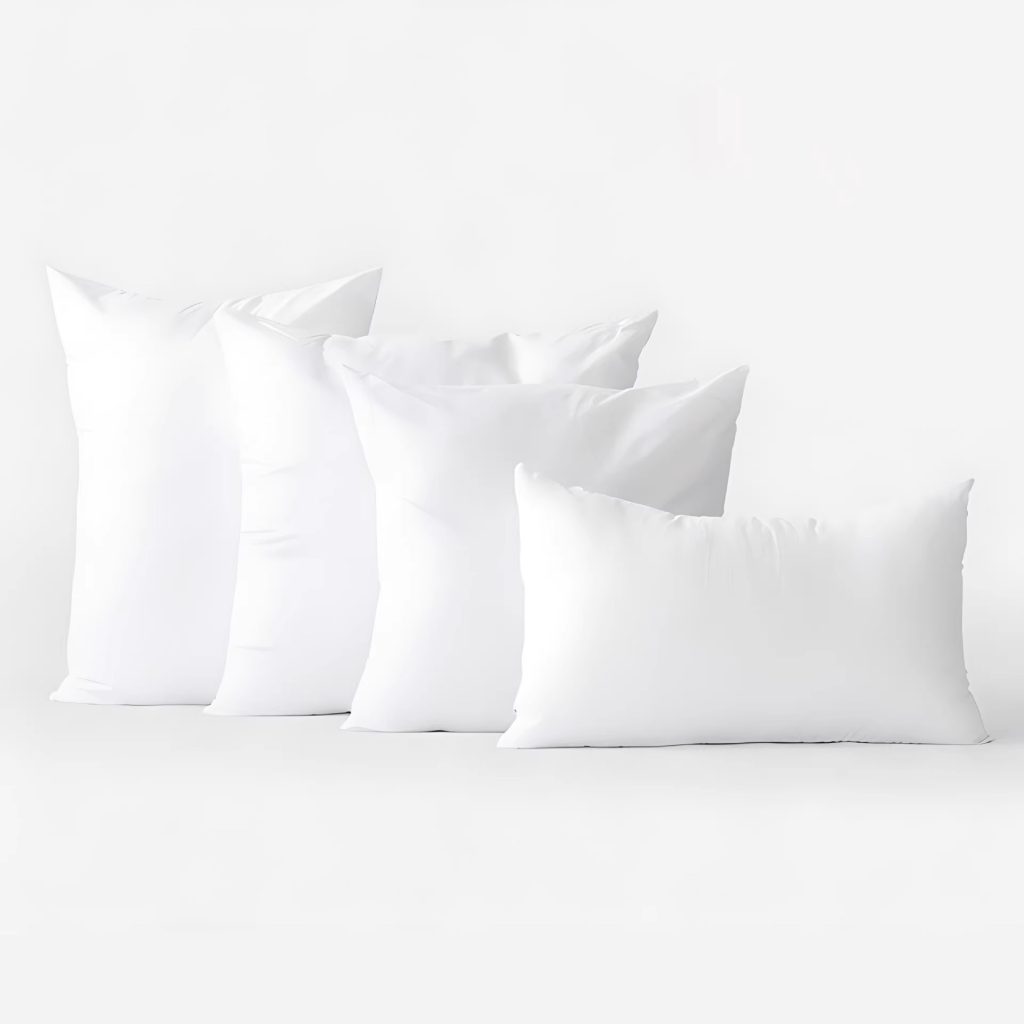
What an Insert Buyer Actually Specifies
An insert is bought on four numbers, and the photo tells you none of them. Shell, fill material, finished size and fill weight are the whole specification, and price follows the last of those most closely. A buyer who sends a size alone gets a quote that cannot be compared with the next one.
The shell here is peach skin over a nonwoven layer, and the fill is PP cotton. Peach skin is smooth against the inside of a decorative sleeve and lets it slide on without gripping, while the nonwoven behind holds the fill in place at the seam.
The format is square, and which square matters: a 45 by 45 cm insert and a 50 by 50 cm insert are different products with different fill quantities. Send the finished size, not a sleeve size and an assumption about the gap. Slightly larger than its sleeve is the usual approach, but the right gap depends on the sleeve fabric.
Fill and Loft
The other number worth settling early is fill weight. The same size can be filled fuller or lighter, and that choice sets the loft, the way the corners sit and the packing volume. Two buyers asking for one size at different fill weights will be quoted different prices, and that is not an error.
Peach Skin Shell and PP Cotton Fill Weight
The shell is a sewn closed bag, with no zip and no way for a shop to top it up. Fill weight is therefore a decision taken at production rather than a service done later, and an insert that arrives light cannot be corrected on the shelf.
PP cotton is a polyester staple fill. In a sewn insert its behaviour is set by how much goes in and how evenly it is spread: a light fill gives a soft, slack cushion that a sleeve can pull into shape, a heavier fill a firm cushion that holds its form with nothing behind it.
Shell and Loading
The peach skin shell is thin, so it does very little to shape the cushion. That is not a fault in the material, it is why fill weight has to be specified rather than inferred. On a filled insert nobody sees the shell, so the only thing judged at retail is how the cushion sits.
For a quote, give the size, the fill weight per piece or the loft you are aiming for, and whether the fill should be loose or compacted. If you only know the loft, say so and the level is set from a sample.
Loft Recovery After Compression Packing
An insert is bulky for its weight, so freight is mostly air. Compression packing presses and bags the units, which cuts carton volume sharply and moves far more pieces per container. The trade-off is that the cushion arrives flat and has to recover.
Shell and Seam
PP cotton recovers well when filled at the right level, but not instantly. Most of the loft returns within a short time of unpacking and the full shape settles over the following day or so, so leave a day between unpacking and display.
Recovery also depends on how hard it was pressed and how long it sat. A light press on a short sea leg behaves differently from a hard press held for weeks, so ask for one carton at the compression level you intend and judge on that rather than on an uncompressed sample.
If you sell inserts as retail items rather than as fillers, look at the bag too. A tightly compressed insert in a plain polybag needs a note telling the customer to let it recover, and that note has to be agreed with the order.
Specification
| Filling format | pillow insert – peach skin shell |
|---|---|
| Format | square |
| Shell | peach skin over nonwoven |
| Fill | PP cotton |
| Shell closure | sewn closed, no zip |
| Fill weight | set per size and per order |
| Loft | light or firm fill |
| Pack method | compression packed |
| Order threshold | confirmed per order |
| Pre-production sample time | 5 to 7 days |
| Run time after approval | 20 to 35 days |
| Settlement terms | T/T 30% deposit, 70% before shipment |
| Terms and port | Ningbo; EXW / FOB / CIF / DAP |
Ordering, Size Grid and Export Terms
The order is built from a size list: each finished size with its fill weight and piece count, priced per line. Two or three sizes in one shipment is normal and does not make it a separate product.
MOQ is confirmed per order, because a light fill and a heavy fill use different amounts of material at one size, and a compressed carton changes how many pieces fit. Shipment runs from Ningbo under EXW, FOB, CIF or DAP, on T/T 30% deposit with the balance before shipment.
Sizes, fill weights and packing are quoted per line, so a mixed list and a single-size list can be compared directly. Our pillow insert range lists the other shell and fill options, and the covers these inserts fill are on the cushion cover page.
FAQ
Should the insert be bigger than the cover?
Usually slightly bigger, so the cover fills out at the corners. How much bigger depends on the cover fabric and the look you want, and it is worth settling on a sample.
Can the fill weight differ from your standard?
Yes, the fill level is set per order. Give the weight per piece you want, or describe the loft you are aiming for and we will set it from a sample.
Can the inserts ship uncompressed?
They can, but uncompressed cartons hold far fewer pieces per container. For a container order the compressed format is normally the only workable option.
Will the shell show through a light cover?
The peach skin shell is white and smooth, so it stays discreet under a light-coloured cover. Very thin or sheer covers are the case to test before a run.
Request a wholesale quote for this pillow insert — send your target size, colourway, quantity and packaging requirements and we will respond with pricing and lead time.